
Initial analysis reviewed on 9 October 2026 at 10:08 Europe/Madrid.
Cisco published the NGOAM and October hardening advisories on 7 October at 16:00 GMT. The NGOAM advisory describes root-level code execution or a device reload through crafted IP traffic, subject to its product, release and feature conditions.
The separate hardening advisory applies to its listed products running vulnerable releases regardless of configuration. Its six CVE identifiers group weaknesses by class; their scores represent the most severe underlying issue in each class.
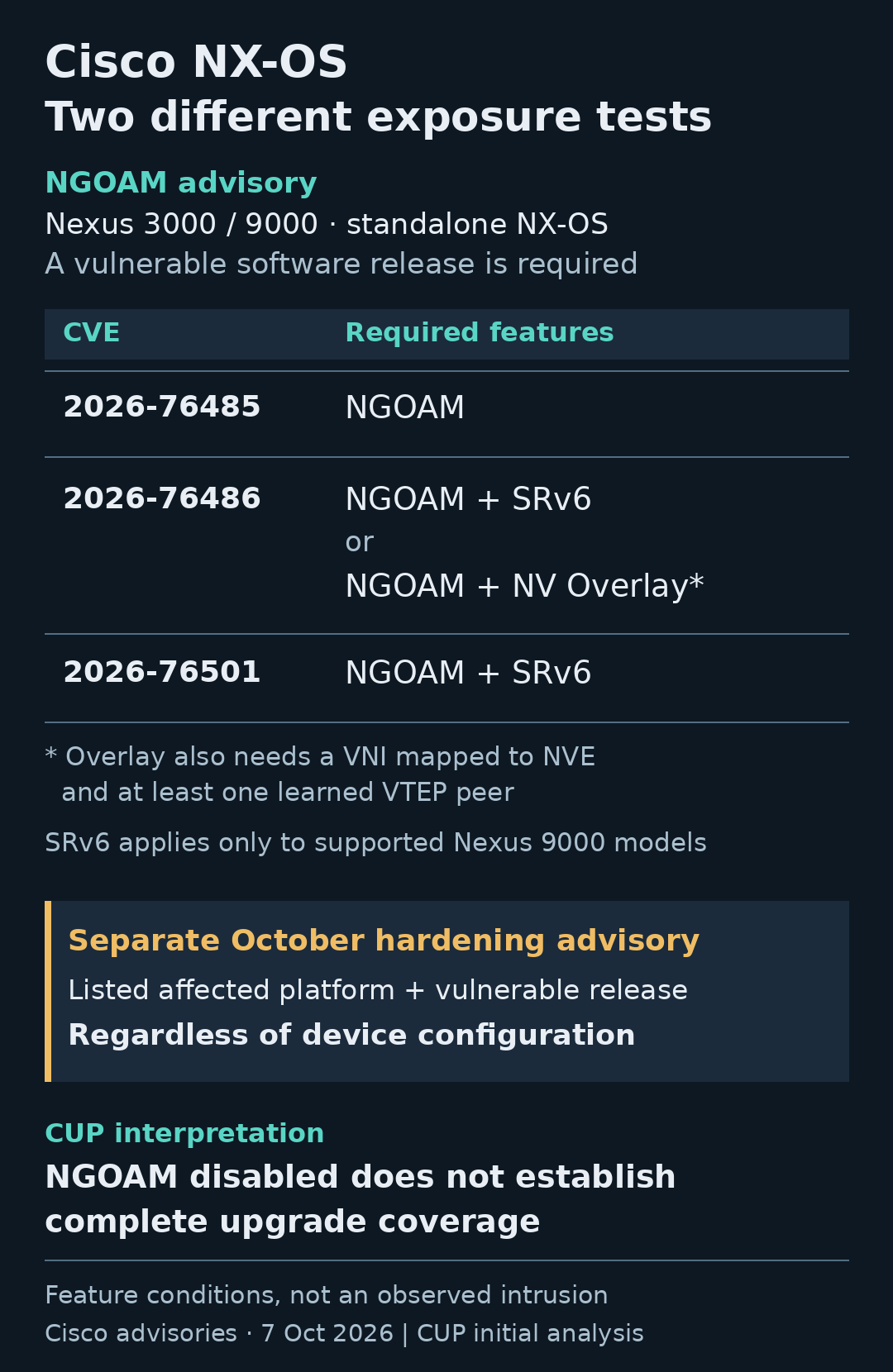
For a network owner, the decision is to establish feature exposure and upgrade coverage separately. Cisco describes disabling unneeded NGOAM as removal of that advisory’s attack vector, not a software fix. This does not remediate the separate hardening issues. The network owner should validate any loss of diagnostics before a feature change. A release selected for one CVE must also be checked against the other applicable advisories.
Cisco reports no known malicious use. Local deployment, reachability and compromise remain unknown. No intrusion, data loss or operational outage is established here.
This interpretation follows CUP’s recent Veeam analysis on distinguishing access conditions from remediation evidence. Revisit the same case if Cisco changes affected or fixed releases, reports exploitation, or supplies a materially different mitigation.
Primary sources
- Cisco NGOAM advisory, version 1.0, published 7 October 2026. Inspected 9 October 2026.
- Cisco October hardening advisory, version 1.0, published 7 October 2026. Inspected 9 October 2026.
Continue this decision.
Move from this analysis into a curated route across related incidents, evidence and operating constraints.