
Atlassian disclosed CVE-2026-21589 on 5 October across several self-managed products, including Jira, Confluence and Bitbucket Data Center. These tools can hold engineering and supplier information, so an unauthenticated file-access flaw deserves an exposure assessment alongside the upgrade plan.
The vendor describes access to specific files inside the web application root. The attacker must already know the exact filename and path; the flaw cannot list directories. Sensitive content may be present in some configurations. This is a vulnerability assessment, not a report of a confirmed intrusion.
Atlassian says affected Cloud products have already been patched and require no customer action. Its sentence about finding no exploitation evidence is in the Cloud discussion; I do not extend it to every self-managed installation.
For affected self-managed products, Atlassian recommends upgrading to a listed fixed release. If that cannot happen immediately, its advisory provides temporary network restrictions and request-filtering options. A WAF or reverse proxy can block the supplied patterns; several products also have application-level rules. Bitbucket’s instructions expressly include cluster nodes, mirrors and mirror-farm nodes.
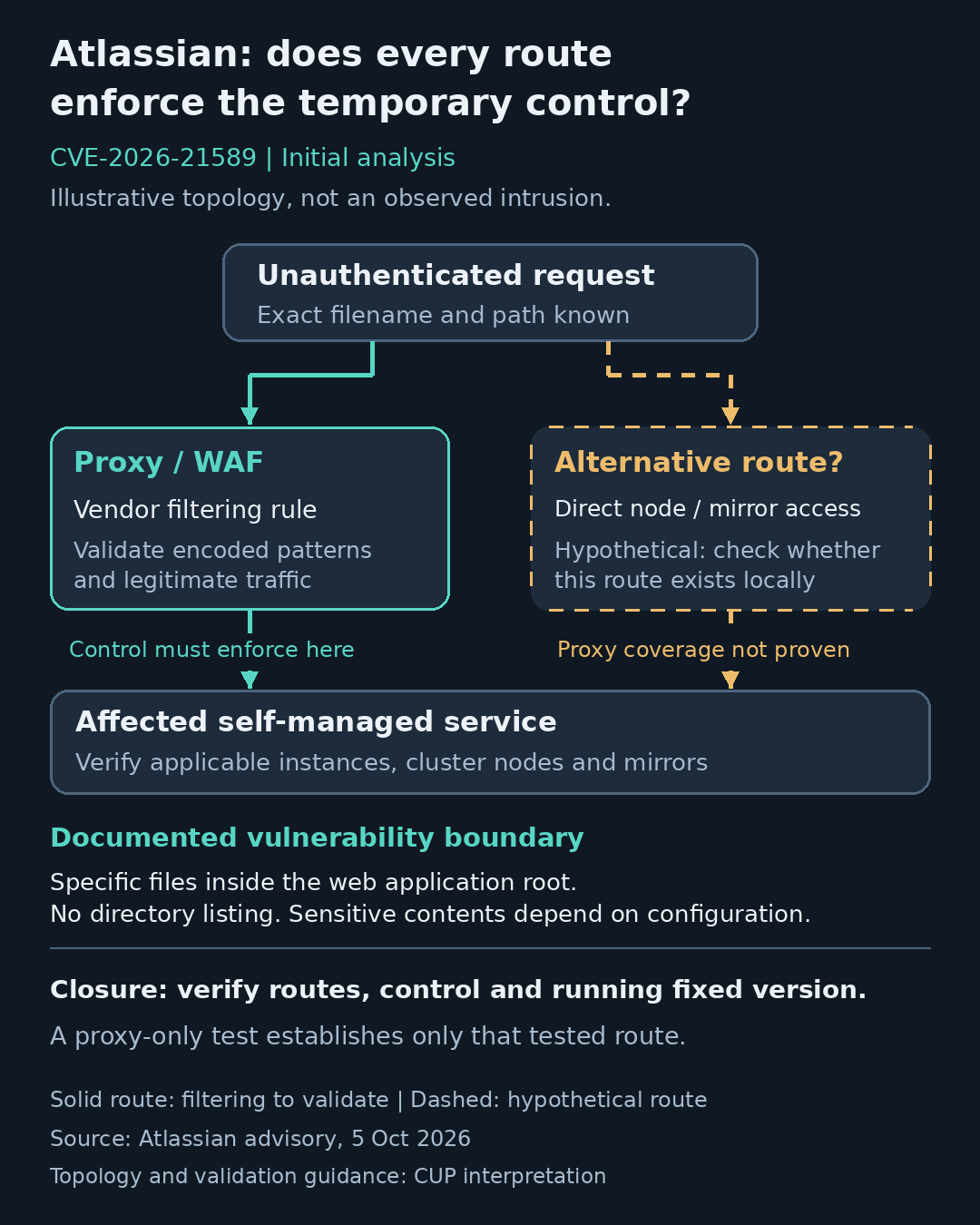
My operational recommendation is to verify mitigation coverage across every route that can reach an affected service. An authenticated public endpoint still needs attention because the vulnerability itself is unauthenticated. Test the vendor’s encoded-pattern cases, confirm the deployed version after restart, and check that legitimate work still functions. A rule recorded in a change ticket is not evidence that every request path enforces it.
The application owner and network administrator should reconcile the instance and mirror inventory with permitted access routes. Test filtering in a controlled environment, retain configuration backups, and validate normal application behaviour before deployment. If filtering disrupts necessary work, use an assessed access restriction while correcting the rule; keep the upgrade as the durable fix.
For example, a hypothetical node reached outside the protected proxy would invalidate a proxy-only mitigation claim. If coverage cannot be demonstrated, restrict that route or bring the upgrade forward, with the application owner’s validation and recovery plan.
The local consequences depend on which files exist and whether they contain sensitive information; neither this advisory nor this analysis establishes data theft in a particular organisation. Revisit the same case if Atlassian changes affected versions, mitigation guidance or its exploitation assessment.
Primary source
- Atlassian official advisory: CVE-2026-21589, published 5 October 2026. Affected products, fixed versions, scope and product-specific temporary mitigations.
Continue this decision.
Move from this analysis into a curated route across related incidents, evidence and operating constraints.