
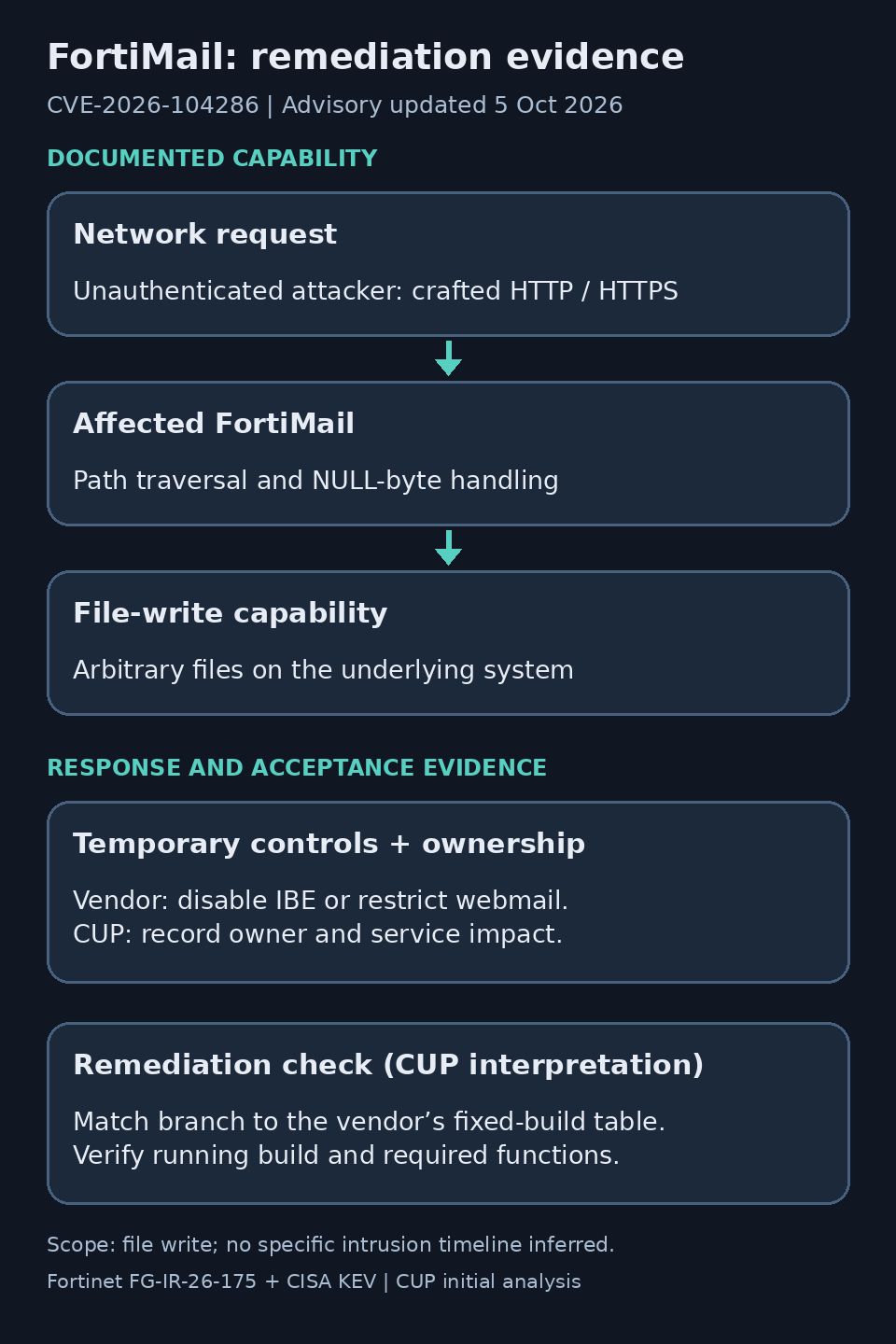
Fortinet's FG-IR-26-175 advisory was published on 1 October and updated on 5 October with a solution update. It describes CVE-2026-104286 as an unauthenticated arbitrary-file-write vulnerability through crafted HTTP or HTTPS requests and reports exploitation in the wild. Its fixed-build table distinguishes FortiMail branches; it also lists temporary IBE and webmail exposure controls.
The professional decision is how to move from an advisory to a verified configuration. An asset owner should identify the actual appliance and deployed branch, compare it with the current vendor table and select the supported remediation route. A listed fixed version does not prove that it has reached production.
Temporary restrictions need an owner, a documented service impact and a condition for removal. In an approved change, verify the running build and the mail or encryption functions the organisation needs, with a recovery plan if validation fails. Retain the result against the appliance, rather than closing only a general vulnerability ticket. These are CUP's operational recommendations, not facts about a particular incident.
Remediation and investigation answer different questions. A software update addresses a vulnerability; it does not establish whether earlier exposure led to compromise. The vendor provides indicators that can support an authorised investigation. Absence of those indicators alone should not be presented as proof that the appliance was never compromised.
The public sources inspected do not establish an affected organisation, exfiltration, ransomware use or a downstream OT consequence. The diagram therefore ends at the documented file-write capability. Recheck this analysis if the vendor changes its affected-version table, solution or exploitation guidance.
Primary sources
- Fortinet FG-IR-26-175, published 1 October, updated 5 October 2026. Mechanism, remediation guidance, controls and reported exploitation.
- Official CISA KEV data, CVE-2026-104286 added 1 October 2026. The addition date does not identify an attack date.
Continue this decision.
Move from this analysis into a curated route across related incidents, evidence and operating constraints.