A successful workshop test covers one path
Consider a diagnostic routine introduced for calibration or maintenance. Its intended function passes the workshop test, but the team has not tested requests outside the allowed vehicle states. This is a hypothetical ECU scenario. It does not identify a flaw in a deployed product or claim that AUTOSAR implementations share one access policy.
AUTOSAR Classic Platform R22-11 specifies diagnostic handling of RoutineControl, UDS service 0x31, including supported routines and configured access checks. This provides a concrete implementation reference. It does not define every product’s physical operating conditions or prove the behaviour of a supplier’s ECU.
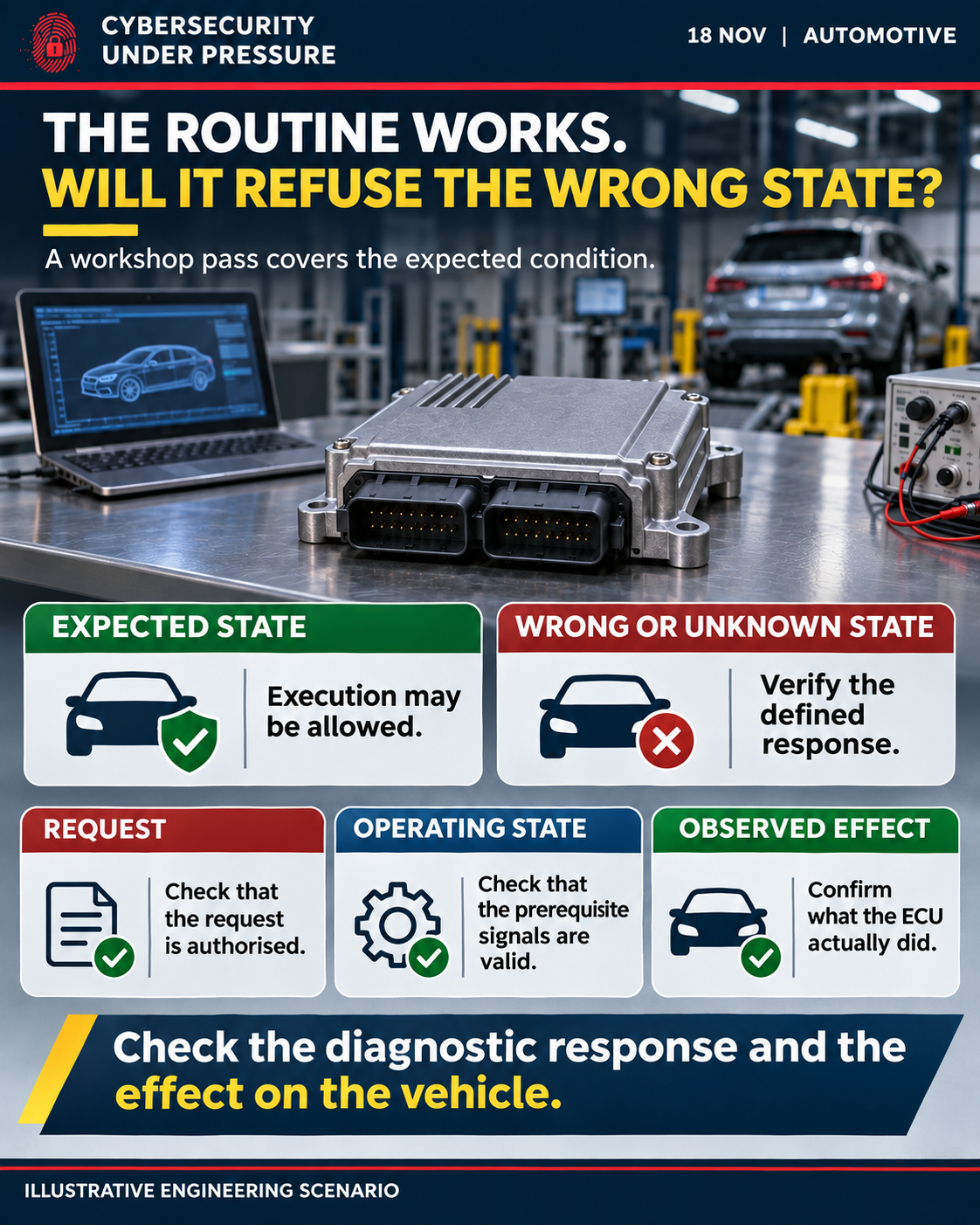
Define the decision at the ECU, not only at the route
Identify the routine identifier, permitted subfunctions, diagnostic session and required authorisation. Establish whether a gateway controls access to the route and which ECU function decides whether the routine can execute. An authenticated connection and an accepted diagnostic session do not, by themselves, establish a valid operating state.
For each state input, specify its origin, freshness, validity and behaviour on loss. A vehicle-speed value, for example, needs a validity interpretation as well as a numeric threshold. A default value that looks like standstill must not silently become permission when the actual state is unknown. The required response follows the routine’s hazard and security analysis.
Check a rejection and its physical effect
A negative response such as ConditionsNotCorrect, NRC 0x22, is an example only when the configured condition and applicable diagnostic specification call for it. Other failures have other responses. Verify the expected response for the exact check rather than requiring the same NRC for every denied request.
The response byte is only part of the evidence. Confirm that a rejected start request does not trigger the routine or modify its target. Separately define what happens if a prerequisite disappears after execution has begun. The implementation could need a controlled abort, completion to a safe state or another specified transition; immediate termination is not a universally safe policy.
HIL or another suitable test setup can exercise timing, missing inputs and state transitions without creating an unapproved vehicle action. Declare its limitations: simulated signals, gateway representation and scheduling differ from the integrated vehicle. Reserve vehicle-level confirmation for the cases whose conclusions depend on that integration.
A compact acceptance matrix
Cover valid operation; the wrong session; insufficient authorisation; an invalid operating state; stale, missing or contradictory prerequisite signals; state change after session establishment; and loss of a prerequisite during execution. For each, record the expected diagnostic result, the expected routine state and the observed target behaviour.
Tie the evidence to the software and calibration configuration tested. The release review should be able to locate both a positive test and the negative or transition tests supporting the execution boundary. A new routine is a small code change only if its additional authority and state dependencies have also been examined.
Sources and evidence scope
Public sources do not demonstrate the hypothetical installation or the proposed test outcomes. The cited editions are the editions used, without claiming that they are the latest applicable editions for every project.
Continue this decision.
Move from this analysis into a curated route across related incidents, evidence and operating constraints.