The acceptance record can outlive the control
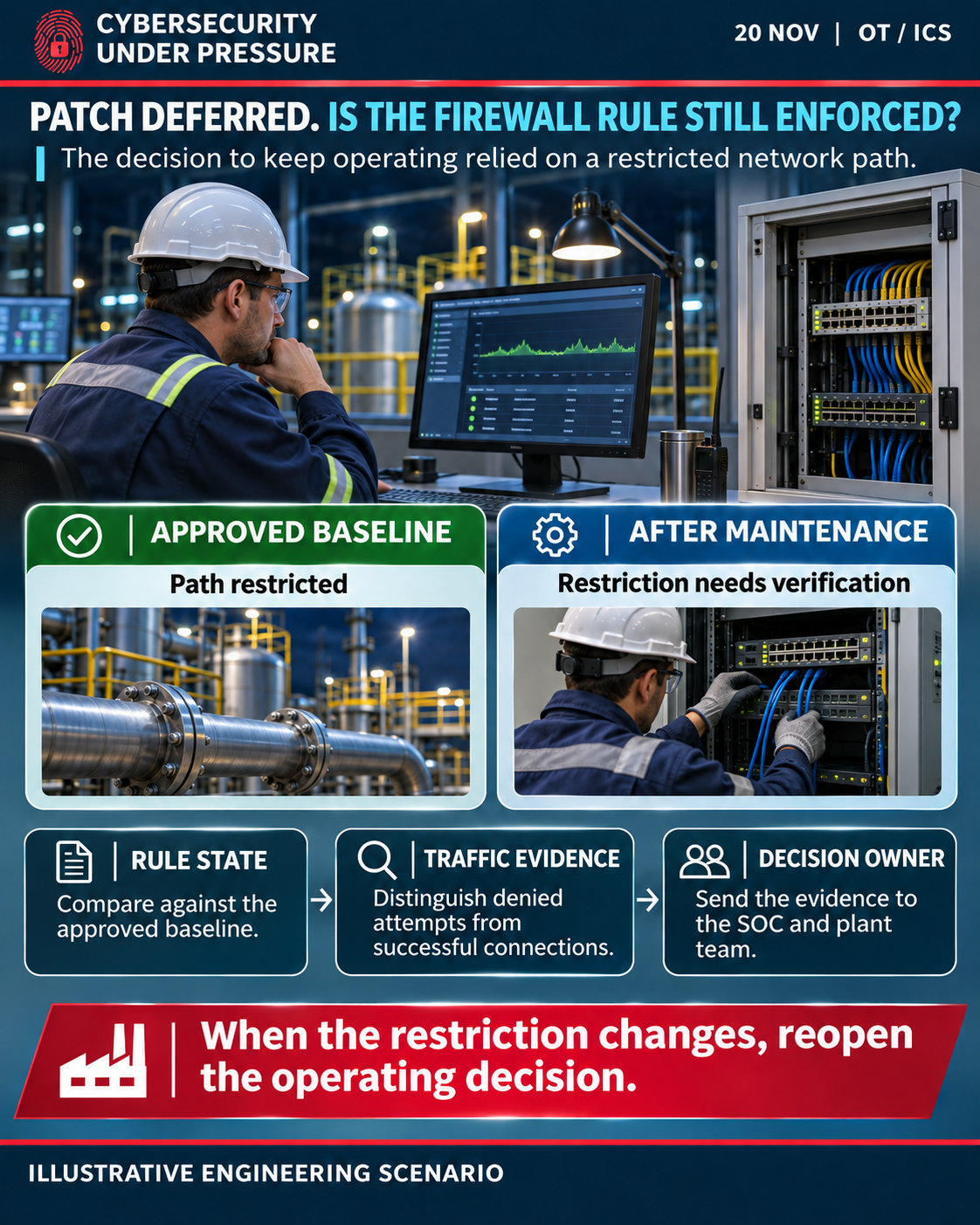
In this hypothetical plant scenario, a security update waits for a validated shutdown. A firewall restriction carries part of the interim mitigation. During a night-shift fault, someone removes the restriction to restore diagnosis. The operating decision still records the vulnerability as mitigated. No specific plant or firewall product is implicated.
The failure concerns a live dependency: continued operation was accepted on the assumption that a particular path remained restricted. A maintenance exception changed that assumption, even if the person restoring connectivity acted legitimately.
Monitor the rule that supports the decision
Record the relevant rule, objects, interfaces, zones, direction and policy order. Where the device supports reliable audit export, send configuration-change events to monitoring. Compare the security-relevant configuration against the approved baseline. A hash over an entire exported configuration detects a difference, but incidental fields can change without altering enforcement.
The alert needs to identify the affected restriction, asset exposure and operating decision. Route it to the SOC and the responsible plant team. If central monitoring is unavailable, preserve local change evidence and provide a local escalation path. Silence from an unreachable collector does not confirm that the rule remains in force.
NIST SP 800-82 Rev. 3 discusses OT patch constraints, configuration management, integrity and ongoing monitoring. The proposed linkage from a rule change to a reopened operating decision is CUP’s engineering recommendation, not a prescribed NIST workflow.
Observe enforcement without confusing an attempt with success
Denied connection attempts show that someone tried to use a route. Allowed traffic or a successful connection supports a different inference. Understand the sensor’s location and semantics before treating a flow record as proof that the protected service is reachable. A configured allow action does not by itself prove that the destination accepted a connection.
Check alternative paths as well as the original rule. A second VPN, a new route or a changed object group can invalidate the mitigation while the original rule text remains unchanged. Use passive evidence where it answers the question. Any active reachability check needs an approved scope and an operationally suitable method; do not turn a monitoring requirement into an unsafe production probe.
An exception reopens the operating decision
An authorised exception should identify its purpose, duration and compensating arrangements. Determine whether diagnosis can continue with narrower access or whether the vulnerability requires earlier intervention. If no supported temporary measure remains, escalate the operating restriction instead of leaving the original acceptance unchanged.
Exercise a relevant rule removal, a harmless configuration change and loss of monitoring coverage. The outcomes differ: exposure changed, configuration changed without known exposure impact, or control state unknown. Each needs an appropriate response. The deliverable is an evidence-backed link between the temporary control and the decision that depends on it, maintained until the permanent correction is deployed and verified.
Sources and evidence scope
Public sources do not demonstrate the hypothetical installation or the proposed test outcomes. The cited editions are the editions used, without claiming that they are the latest applicable editions for every project.
Continue this decision.
Move from this analysis into a curated route across related incidents, evidence and operating constraints.