
Imagine a field user receives an apparently valid result from a shared law-enforcement database while responders investigate the system that delivered it. The immediate question is what evidence makes that specific result safe to use for the decision at hand.
1. What was reported about NCIC
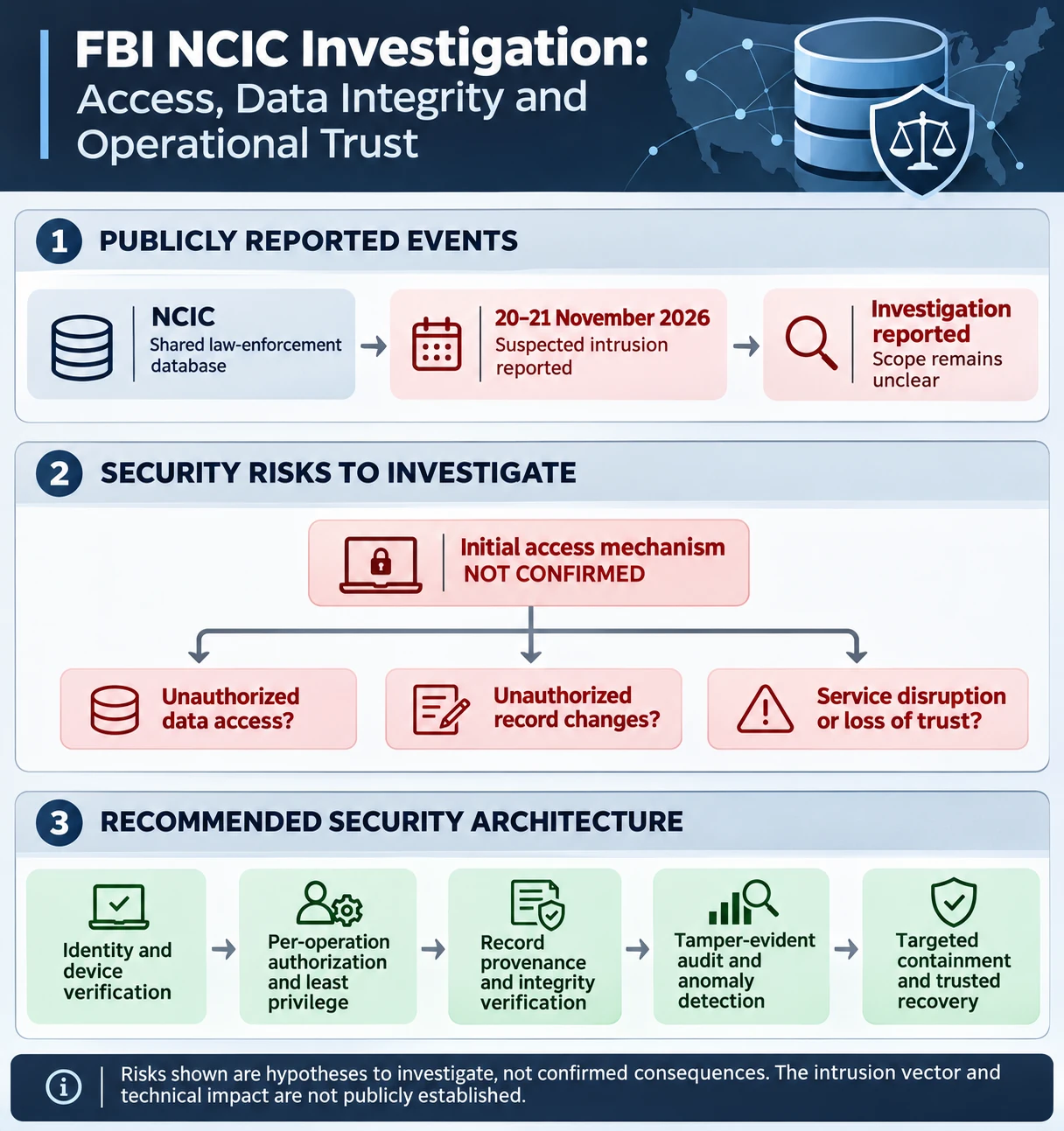
The FBI describes NCIC as an information system used by authorised federal, state and local agencies. On 21 November, the Associated Press reported that the FBI was investigating an apparent intrusion, citing a person familiar with the matter. The FBI declined to comment to AP, and the scope was unclear.
2. What investigators need to establish
Check separately for unauthorised access and unauthorised changes. Queries can reveal sensitive records or the subjects an agency is investigating. An incorrect, stale or missing record can affect a decision even where investigators find no extraction. These are scenarios to test against evidence from the affected environment.
3. Architecture for decisions that depend on shared records
Assign authority for temporary restrictions and specify the identity, record history and independent audit evidence required before restoring confidence in results.
Enforce least privilege for each operation, with distinct authorisation for queries, updates and bulk actions. Maintain record provenance and change history so investigators can verify the actor, source, time and approval behind a change. Send critical events to tamper-evident storage with separate administrative control. Monitor for unexpected query volume, unusual record changes and loss of audit visibility.
During an investigation, scope restrictions to affected capabilities, agencies or data when evidence supports that decision. Provide an authorised alternative verification route for consequential decisions and state clearly when users must use it. Before restoring affected functions, reconcile a defined set of records against trusted upstream evidence, check the audit timeline for gaps and obtain approval from the responsible operational authority.
The same decision appears in industrial environments when maintenance personnel rely on a shared asset or work-order record. An important field action may require an independent check if the system that supplies the record is under investigation. The owner should decide in advance which actions can continue and which must wait.
Sources
- Associated Press, 21 November 2026. Report of the suspected incident and the limits of public evidence
- FBI, Criminal Justice Information Services. NCIC’s role in the CJIS portfolio
- FBI, The CJIS Advisory Process. Shared governance of systems administered through CJIS
Continue this decision.
Move from this analysis into a curated route across related incidents, evidence and operating constraints.