
The Decision
For a customer-managed HA pair, treat the change as complete only after both appliances report an applicable fixed build and the planned user journey works after a controlled failover. This is a proposed acceptance check, not a test result or a Citrix requirement.
What the advisory establishes
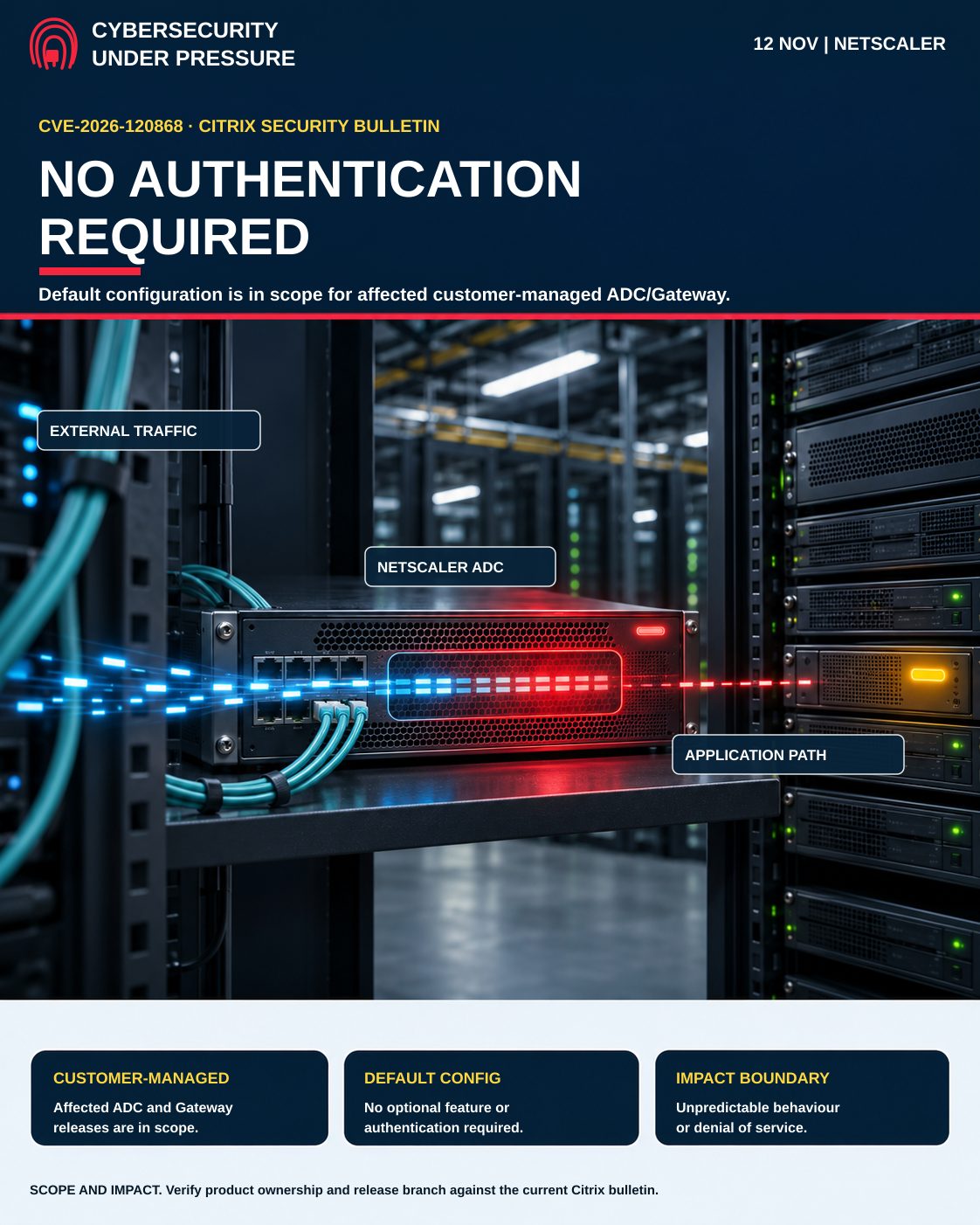
Citrix bulletin CTX697305 describes CVE-2026-120868 as a memory overflow in NetScaler packet processing. On affected releases, the issue applies to customer-managed NetScaler ADC and Gateway deployments, including the default configuration. The bulletin lists no additional feature or setting as a prerequisite. It assigns CVSS v4.0 9.3 and describes the possible result as unpredictable or erroneous behaviour, or denial of service.
The CVSS vector includes high confidentiality, integrity and availability impacts. The vendor's prose describes unpredictable behaviour or denial of service. Do not translate the score into a claim of remote code execution or confirmed compromise without separate evidence.
Citrix's bulletin applies to customer-managed appliances. It says Citrix-managed cloud services are upgraded by the provider. If you use a managed service, confirm its status with the provider rather than applying appliance instructions yourself.
Use the correct fixed build for each branch
The values below are the minimum fixed builds listed in the 12 November bulletin. Check the latest vendor release and branch guidance before scheduling, and verify the build actually running on every appliance after the change.
| Product and branch | Minimum fixed build in CTX697305 |
|---|---|
| NetScaler ADC and Gateway 14.1 | 14.1-73.57 |
| NetScaler ADC and Gateway 13.1 | 13.1-64.39 |
| NetScaler ADC 14.1 FIPS | 14.1-73.58 FIPS |
| NetScaler ADC 13.1 FIPS / NDcPP | 13.1-37.293 |
Citrix also notes that customer-managed NetScaler instances used by Hybrid Secure Private Access are in scope. The vendor bulletin recommends upgrading supported affected versions.

Prioritise exposure, then validate the service
CERT-EU recommends upgrading internet-facing Gateway and AAA appliances first. It reported that Citrix had seen no exploitation and that no public proof of concept had been confirmed in its 12 November advisory. That statement describes the evidence available at that time. It does not establish the state of any individual appliance, and it may change as new evidence appears.
For a redundant pair, agree the maintenance window, recovery limit and rollback authority with the service owner. Capture a representative baseline before the change. After upgrading, record the running build and HA role on both nodes. Then, under the approved change plan, perform a controlled failover and test a fresh authentication and the expected application path. A management interface responding does not prove the user-facing service recovered.
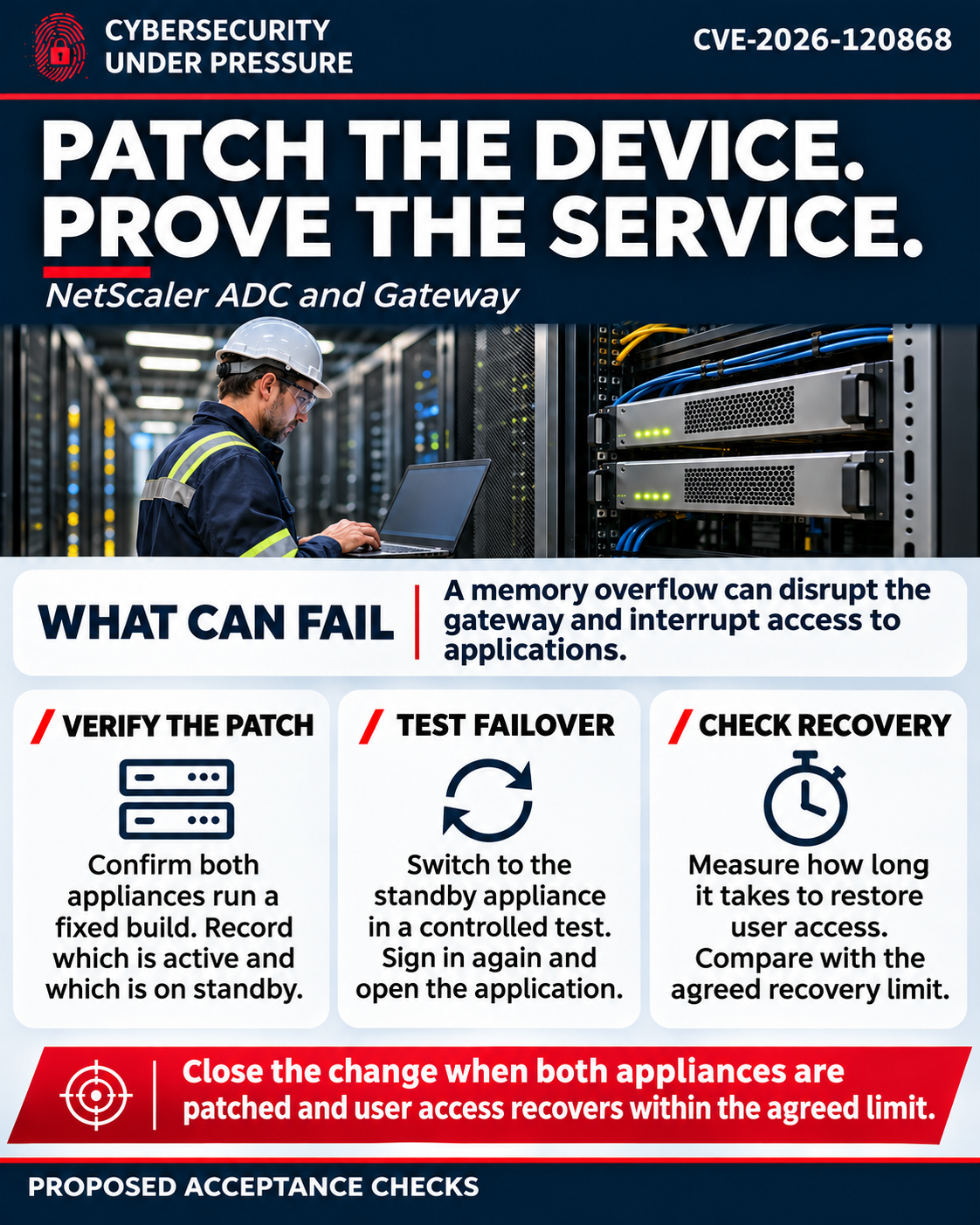
If the application misses its agreed recovery limit, follow the approved recovery plan. If rollback would restore a vulnerable build, make that exposure an explicit risk decision with the service owner. Do not silently treat the rollback as a completed remediation.
When the gateway supports industrial maintenance
First confirm from the approved architecture or dependency map that the remote maintenance route actually traverses this gateway. The vulnerability advisory does not establish an impact on a specific plant or production process. If the dependency is real, coordinate the window and recovery boundary with operations, check the authorised route using an approved test account, and agree how local staff retain authority if remote access fails. Do not send commands to production equipment as part of this validation.
Sources and evidence limits
- Citrix, CTX697305, NetScaler ADC and Gateway Security Bulletin. Scope, impact wording, affected releases and fixed builds. Initial publication 12 November 2026.
- CERT-EU, Security Advisory 2026-020, v1.0, 12 November 2026. Prioritisation and exploitation / public PoC status as reported at publication.
This analysis distinguishes vendor facts from CUP's proposed operational acceptance criteria. It contains no claim of a specific compromise, service outage or industrial impact. Recheck the vendor bulletin before implementation because versions and threat reporting can change.
Continue this decision.
Move from this analysis into a curated route across related incidents, evidence and operating constraints.