
Crédit Mutuel Arkéa’s account of the attack disclosed on 4 November identifies a service provider’s platform as the route into the bank. The bank says attackers used its own account to send money to other banks. That raises a specific review question for organisations with payment integrations: what limits the transactions a connected provider can cause?
What the bank has confirmed
In its initial statement, Arkéa described fraudulent transactions, a precautionary suspension of some transactions and a progressive restart following checks and additional security measures. Its subsequent clarification says the entry was through a provider’s platform, rather than Fortuneo. It says customers’ assets were unaffected, although some transfers were delayed.
The bank does not confirm the reported €118 million as a final loss. It validates only the order of magnitude, says part of the funds was blocked and reports continuing recovery efforts. Conversion to cryptocurrency is described as a possibility. Those distinctions matter: money involved, money transferred, money blocked and final loss are different measures.
What the public account does not establish
The statements do not identify the provider, entry vulnerability, credential or token involved, transaction interface, approval architecture or detection timeline. They do not establish which preventive controls failed. Describing this as a confirmed API flaw, an MFA bypass or a failure of dual approval would go beyond the inspected evidence.
The analysis below is a set of engineering review questions prompted by that account. It is not a reconstruction of Arkéa’s systems or a claim that a particular control would certainly have prevented this incident.
The Decision
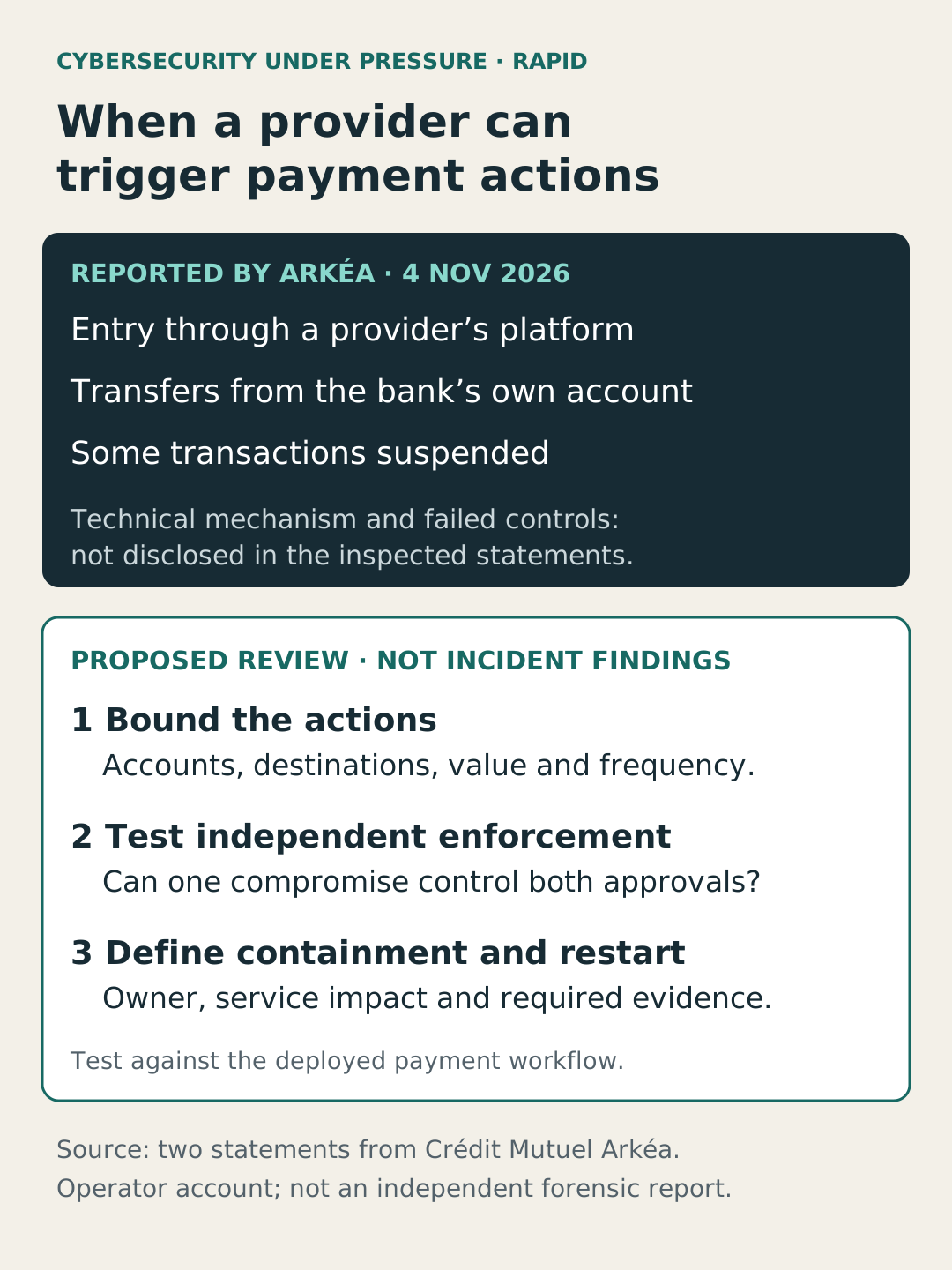
Review the actions each payment integration can cause, test independently enforced transaction limits and define who can suspend and restart the service.
Review the effective transaction authority of each connected payment service. Record which accounts it can affect, which actions it can initiate or complete, the permitted destinations, and the limits enforced outside the provider’s control. A network connection or authenticated identity alone does not describe that authority.
For each integration, test whether restrictions still hold when its credentials or execution environment are assumed compromised. Examine cumulative value and transaction frequency alongside individual payment limits. Several permitted transfers can create an unacceptable aggregate exposure even when each remains below a per-payment threshold.
For higher-risk actions, assess destination allowlists, separate approval for beneficiary changes and independent transaction validation. Independence needs evidence: a second approval offers limited separation if the same compromised environment can control both steps. These options must fit the payment workflow; a manual approval on every routine transaction can introduce delays and encourage bypasses.
Containment has a service consequence
Arkéa’s temporary transaction suspension illustrates that containment can delay legitimate activity. For another organisation, a restricted mode could hold selected transfers for review or disable a particular provider route while preserving unaffected services. Whether that is possible depends on the architecture and must be tested before an incident.
Name who can suspend the integration, who accepts the operational consequences and who authorises restart. Preserve provider, identity, approval and transaction records with timestamps and correlation identifiers so investigators can distinguish attempted, authorised, executed and blocked actions. A restart decision should address both the compromised route and the validity of the controls being relied upon.
Three views of the same operating decision
Executive: define acceptable exposure during detection and response, identify the services a suspension would interrupt and assign authority to accept a restricted operating mode.
Engineering: test account, destination, cumulative-value and frequency restrictions against a compromised integration. Show where approval independence is enforced and what happens when a dependency is unavailable.
Assurance: retain the tested configuration, results, control owners and restart criteria. A supplier assurance report should complement evidence from the deployed integration.
These questions also matter where third parties operate industrial systems, but the protected actions and safe containment choices differ. This banking incident establishes no compromise of an industrial process.
Primary sources
- Crédit Mutuel Arkéa, initial attack statement, 4 November 2026. Transaction suspension, progressive resumption and customer impact. Inspected 4 November 2026.
- Crédit Mutuel Arkéa, additional information, 4 November 2026. Provider route, bank-owned account, amount uncertainty and recovery. Inspected 4 November 2026.
Both documents are statements from the affected bank. They are not independent forensic confirmation.
Review trigger. Revisit this analysis if the bank, the provider or an investigating authority discloses a technical mechanism, changes the customer-impact assessment or consolidates the loss figure. Recheck sources before release.
Continue this decision.
Move from this analysis into a curated route across related incidents, evidence and operating constraints.