
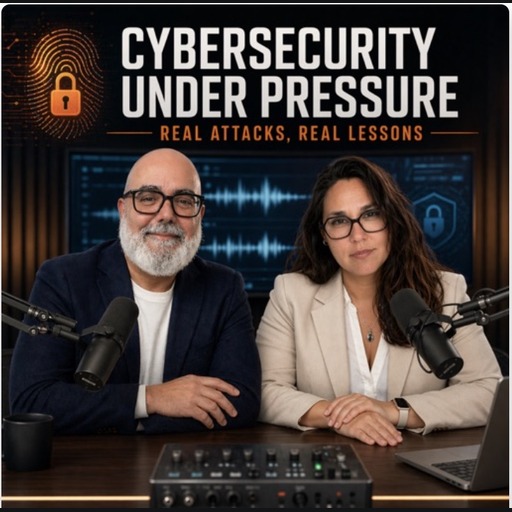
Listen to the full episode.
Navigate the reasoning, not just the runtime.
Four editorial phases and the conclusions worth carrying into a technical or risk discussion.
Chapters
How CVE-2026-3014 lets an authenticated edit-capable Siveillance user cross the application boundary into code execution in the Management Server Service context.
How to map user role, API, service account, host privileges and reachable management assets while deploying the fixed product versions.
What changes when legacy integrations or maintenance constraints delay patching and exposure must be constrained without misrepresenting compensating controls as a fix.
Why least privilege must constrain the complete authority chain rather than stopping at the role visible in the application interface.
Key takeaways
- CVE-2026-3014 requires authenticated edit permissions but can execute code in the Management Server Service context.
- Application roles should be reviewed together with service identity, host privilege and management-network reach.
- Enclaves, bastions, PAM, MFA and session monitoring can reduce exposure where supported but do not remediate the software defect.
- The Siemens fixed versions remain the primary remediation and should be validated against the management workflow after deployment.
Editorial chapter map. Timecodes appear only when validated against the published audio; none are inferred from duration or section names.
What this episode examines
The episode examines how an apparently bounded application permission can expand into system-level authority when the underlying service runs with broader privileges than the user role suggests.
The Technical Breakdown
CVE-2026-3014 requires an authenticated Siveillance user with edit permissions but can cross the application boundary and execute arbitrary code in the context of the Management Server Service.
The Operational Decisions
Teams need to map the full authority chain from user role to API, service account, host privilege and reachable management assets, while deploying the fixed Siemens versions.
The Pressure Test
When immediate patching is constrained by legacy integrations or maintenance windows, management-plane isolation, controlled administrative access and monitoring can reduce exposure without pretending to remove the software defect.
The Key Takeaways
Least privilege is only defensible when it constrains the complete authority chain, not merely the role shown in the application interface.