
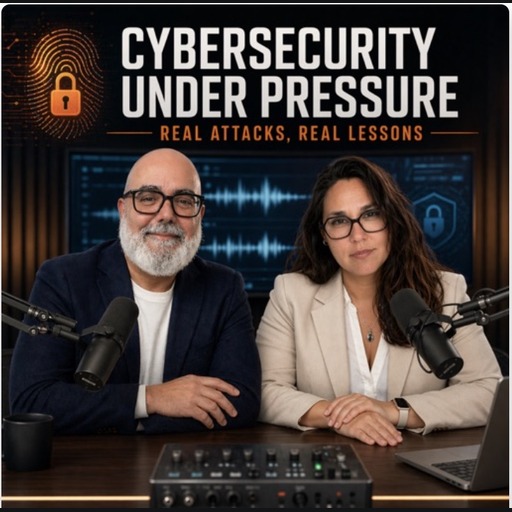
Listen to the full episode.
Navigate the reasoning, not just the runtime.
Four editorial phases and the conclusions worth carrying into a technical or risk discussion.
Chapters
How AI-assisted scripting changes attacker speed while controller reachability, engineering paths and protocol authority still determine operational consequence.
How teams identify which S7 controllers are reachable, who can perform state-changing operations and which conduits can be restricted without breaking production.
What changes when a suspect engineering path is operationally required and containment must reduce attacker authority without creating a plant outage.
Why defending Siemens S7 environments should focus on bounded process authority and behavioural evidence rather than the provenance of the attack script.
Key takeaways
- AI can accelerate reconnaissance and tooling without creating the trust path that reaches the industrial process.
- Reachability plus process-changing authority determines consequence more directly than whether attack code was AI-generated.
- Defenders should baseline engineering sources, maintenance windows and state-changing controller behaviour.
- Containment should scope restrictions to the suspect conduit or identity so production can remain safely operable where possible.
Editorial chapter map. Timecodes appear only when validated against the published audio; none are inferred from duration or section names.
What this episode examines
Recent reporting around Siemens S7 targeting has focused heavily on AI-assisted exploit and interaction scripts. This episode separates attacker acceleration from the architecture that determines operational consequence.
We examine why a generated script only becomes an OT security event after it crosses a real trust boundary: internet exposure, compromised remote access, an engineering workstation or another path that can legitimately reach the controller. The important question is then what authority that path has over PLC state, logic and process parameters.
The discussion moves to detection. Static signatures are fragile when tooling can be rewritten quickly, so defenders need baselines for legitimate engineering sources, maintenance windows, TCP/102 relationships, controller state transitions and approved project changes. Those cyber signals are most useful when they can be correlated with process evidence.
Finally, we look at containment that respects plant continuity. The goal is not blanket disconnection. It is the ability to restrict a suspect engineering conduit or identity without unnecessarily disrupting unrelated production.
The practical lesson is that AI may make attack development cheaper, but process authority is the security property that determines whether the attack matters physically.