An unresolved credential becomes a commercial argument
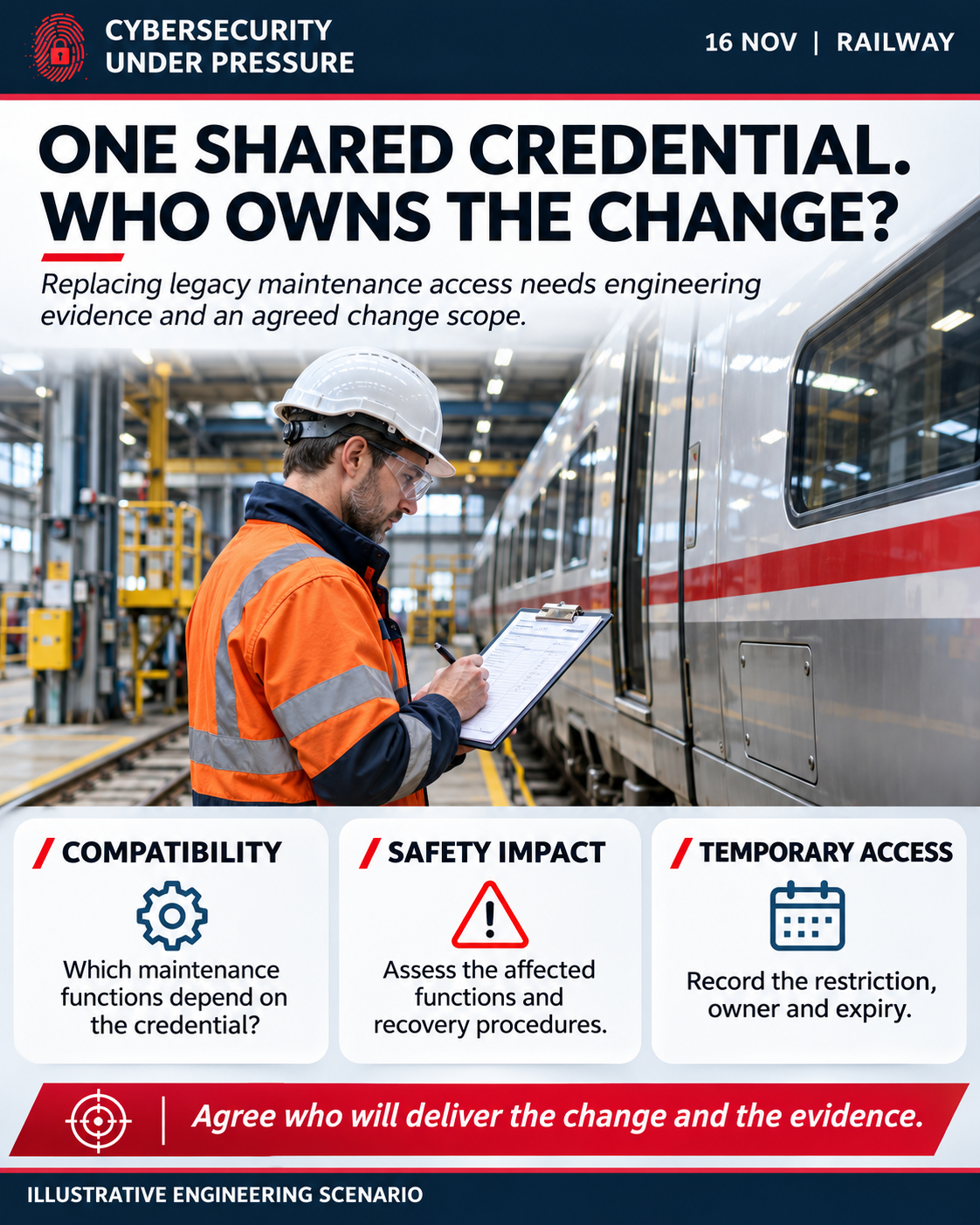
Consider an illustrative legacy train installation. A ground diagnostic platform reaches onboard maintenance services through a train-to-ground gateway. A subsystem tool depends on a shared maintenance credential that the operator cannot replace independently. The supplier quotes an engineering change; the operator disputes the cost. This is a hypothetical scenario, not evidence of a named railway deployment.
The engineering question is how to reduce exposure while preserving supported maintenance and recovery. The commercial question is who provides and pays for the modification and its evidence. A safety impact assessment connects them, but does not itself establish the contractual answer.
Do not turn the Safety Case into an automatic prohibition
A proposed credential or access change needs a specific assessment of affected functions, interfaces, assumptions and maintenance procedures. Avoid claiming that any configuration change necessarily invalidates a Safety Case or automatically requires an external assessment body. The project’s applicable assurance and authorisation arrangements determine the required route.
ENISA’s railway risk-management publication provides sector context for tailoring methods to railway undertakings and infrastructure managers. It does not document the shared-credential scenario or settle engineering-change costs. The containment and decision process developed here are CUP’s recommendations.
Locate an enforceable restriction
Map the ground identity, diagnostic service, gateway path and onboard maintenance interface. Determine whether an attacker possessing the credential can use only the intended tool or can establish another connection. Identify any fallback route, depot access path or supplier service that bypasses the proposed restriction.
A restriction on the ground platform or gateway can narrow access without changing the subsystem. It does not remove the shared credential or prove that the onboard network is protected from another foothold. Document that residual exposure. Check the effect on fault diagnosis, loss of connectivity and recovery, including who can authorise a temporary exception.
Use available configuration and supplier evidence before proposing an intrusive fleet test. If the subsystem cannot be reproduced in a test environment, define which integration assumptions can be checked elsewhere and which require a controlled intervention. Do not describe untested compatibility as confirmed simply because the change is small.
Commission the evidence, not an open-ended dispute
Separate the proposed work into deliverables: credential lifecycle options, interface compatibility, safety impact assessment, implementation, regression scope and deployment procedure. Ask the supplier to identify exactly which part of the change creates the cost or assurance dependency. The operator can then compare a permanent change with time-bounded containment using explicit limits.
While responsibility is being resolved, record the operating decision and the restrictions actually in force. Establish a deadline and escalation route for the unresolved engineering scope. Neither a disputed quotation nor an unchanged Safety Case demonstrates that the current access arrangement remains acceptable. The decision record must explain why continued operation is supportable for the stated period.
Sources and evidence scope
- PRIMARY CONTEXTENISA, Railway Cybersecurity: Good Practices in Cyber Risk Management
- PRIMARY CONTEXTNIST SP 800-82 Rev. 3, access and operational constraints
Public sources do not demonstrate the hypothetical installation or the proposed test outcomes. The cited editions are the editions used, without claiming that they are the latest applicable editions for every project.
Continue this decision.
Move from this analysis into a curated route across related incidents, evidence and operating constraints.