
1. What public reporting established
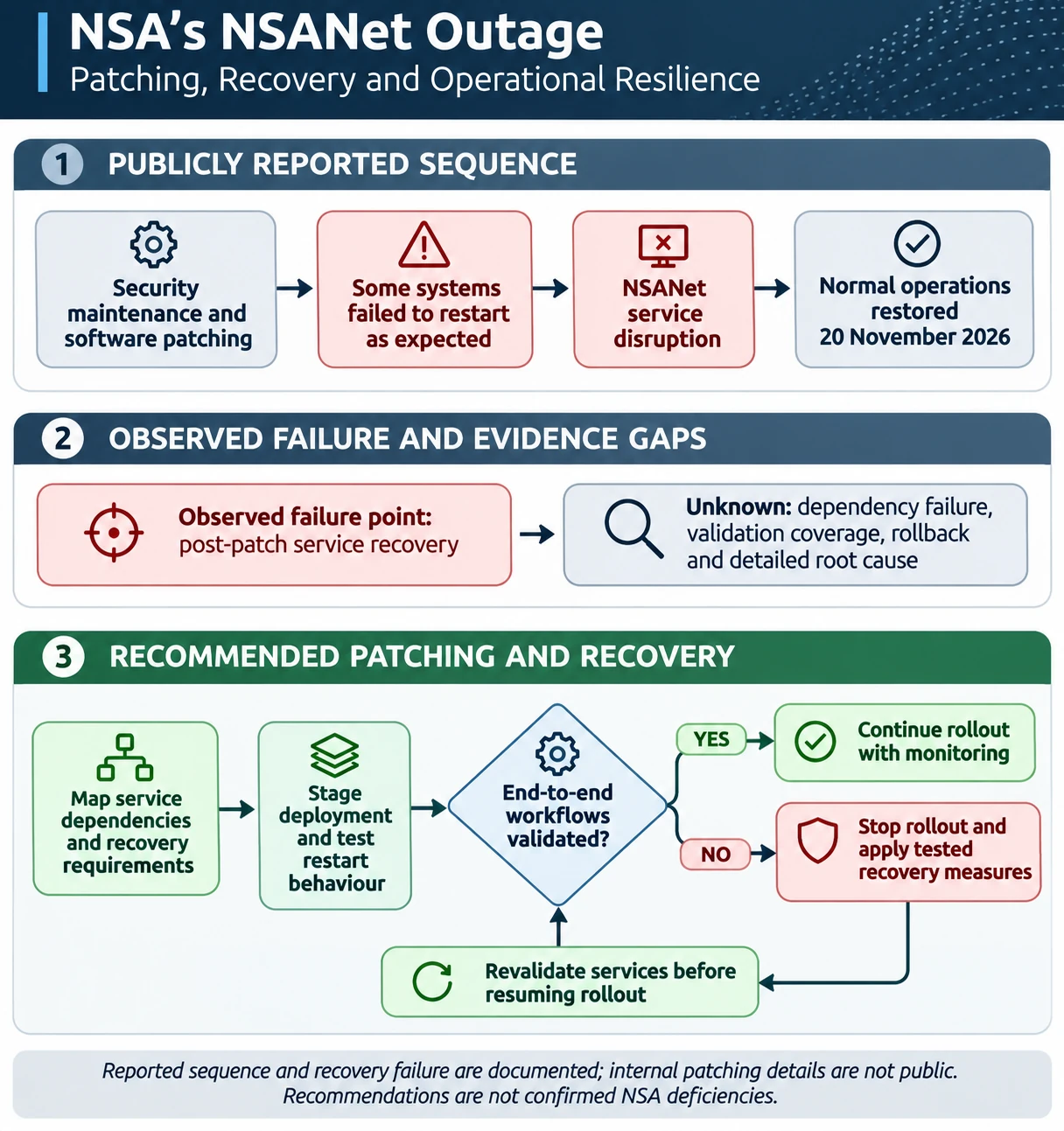
On 17 November, the NSA said scheduled maintenance caused temporary degradation of some internal systems and said mission-critical capabilities remained operational. Associated Press reporting identified NSANet as the affected classified internal communications network. Subsequent reporting linked the outage to software patching and quoted a US official saying some systems failed to come back as expected. On 20 November an NSA spokesperson confirmed the agency had returned to normal operating conditions.
2. Where the available evidence ends
A restart problem was reported. The public record does not identify the deployment rings, the dependencies that prevented the service from recovering, the validation coverage or any rollback attempt. The outage prompts a practical design review for organisations facing a compressed patch window.
3. Recommended patching and recovery process
Advance an urgent rollout only after a representative service has restarted and passed an end-to-end transaction. Give the change owner an explicit pause condition and a proven recovery route.
Map the service dependencies needed for a cold start, including identity, configuration stores and monitoring. Select a deployment group with representative dependencies and an acceptable operational failure domain. Record the service checks, acceptable interruption, maximum recovery time and who can stop the rollout.
Check that the patch took effect and run an end-to-end workflow through the path users actually depend on. For a maintenance system supporting industrial operations, verify the agreed operator or maintenance workflow with Operations. Preserve independent visibility while the affected service restarts.
If verification fails, stop expansion. Use the tested recovery path and check whether it restores the previous exposure. Where a security fix cannot safely be rolled back, use a rehearsed forward recovery or a restricted service mode with a defined expiry. Validate service behaviour and security state before resuming rollout.
Suppose maintenance replaces the runtime on a fleet of engineering gateways. A successful package installation gives the change team evidence at the host level. A safe continuation decision also needs a fresh authenticated session on a representative gateway and proof that operators can resume the approved workflow.
Sources
- Associated Press, 17 November 2026. NSA statement and reported NSANet disruption
- The Record, 20 November 2026. NSA statement on restored operations and the reported restart problem
- NIST SP 800-40 Rev. 4. Enterprise patch management and verification guidance
Continue this decision.
Move from this analysis into a curated route across related incidents, evidence and operating constraints.